History
Golf has been played on this ground since 1885. The game’s vocabulary hasn’t been the same since.
One hundred and forty years of officers, ladies, moats, MoD fences and Solent weather — and one autumn afternoon in 1892 that gave golf the word every player in the world now mutters.
1885
The United Services Golf Club
The club was founded in 1885 as the United Services Golf Club, for Army and Navy officers stationed around Portsmouth — the greatest naval harbour in the world, a short pull across the water. The original layout ran over Haslar Common and the glacis of Fort Monckton: golf played on military ground, between the guns and the sea.
The course still lives on that ground. Fort Monckton still watches over the 17th that bears its name, the 18th — Lunette — is named for the fort’s outworks, and the old defensive earthworks still decide which way your ball kicks.
1890 – 1892
Where Bogey was born
In 1890, a new idea was moving through English golf: the “ground score” — a fixed standard for each hole, an invisible opponent who never took three putts and never found the moat. Clubs began playing matches against this perfect phantom, and a music-hall song of the day gave him a name: the Bogey Man.
In 1892 the Secretary of Great Yarmouth Golf Club — an evangelist for the new scoring — visited the club here at Haslar. Playing with our Honorary Secretary, the ground-score idea was worked out on this course, hole by hole. And somewhere out on the links came the tee-side suggestion that has echoed ever since: a standard this steady, this immune to nerves, deserved a military rank.
Every regiment has its colonel. The perfect player who never dropped a shot was commissioned on the spot: Colonel Bogey.
The name marched out of golf and into the world — a regimental whistle, a famous tune, a word in every language the game is played in. It was coined here, on a members’ course between a Victorian fort and the Solent. When your ball finds the water at the 5th — Watery Grave, on the card — you are losing to the same opponent the officers invented in 1892.
1893
The ladies of Alverstoke
In 1893 the ladies of Alverstoke established a course of their own beside the Services ground — eight years after the men, and decades ahead of much of English golf. Around 1900 the two courses merged into a single eighteen-hole layout, and the combined club took the shape it still has: one course, shared ground, everybody plays.
More than a hundred and thirty years on, the arrangement they started still stands: the women’s card carries its own pars and stroke indices over the same eighteen holes.
1900s
The changing course
The twentieth century kept redrawing the map. Fort drainage schemes and the infilling of sections of moat altered old holes; sales of Ministry of Defence land trimmed the boundaries. The club answered with an old links solution: eighteen tees serving eleven greens — seven greens doing double duty, four holes keeping greens of their own. What survives is not a compromise but a signature; there is no routing like it on this coast.
1939
A new name, a wider club
Shortly before the Second World War the club took its present name — Gosport & Stokes Bay Golf Club — as membership opened beyond the services to the town around it. The salt-air military inheritance stayed; the mess-room formality went.
1985
A century, celebrated
The club marked its centenary in 1985 — a hundred years of golf on the point. Today it is a Community Amateur Sports Club, owned by no investor and answerable to nobody but its members.
Today
The clubhouse, refurbished; the wind, unchanged
The recently refurbished clubhouse looks down the 18th and out to the water — live music on Fridays, honours boards on the walls, silverware in the cabinet that the United Services officers would recognise. The honours boards themselves deserve a page of their own; it is being compiled.
One hundred and forty years on, the essential facts hold: 5,810 yards, par 70, eleven greens, one wind — and a course that still asks whether you can beat the Colonel.
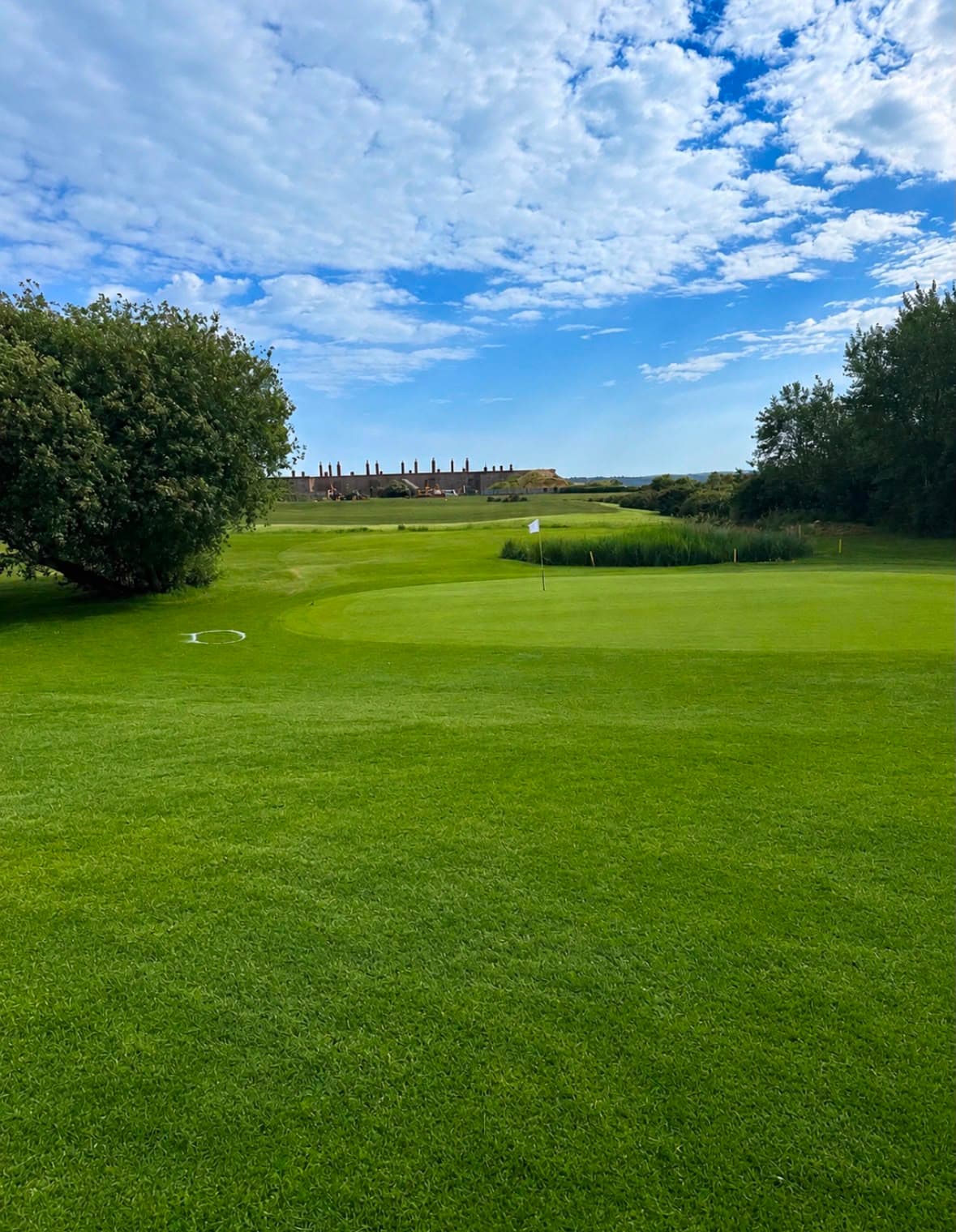
The 14th, looking back at Fort Gilkicker
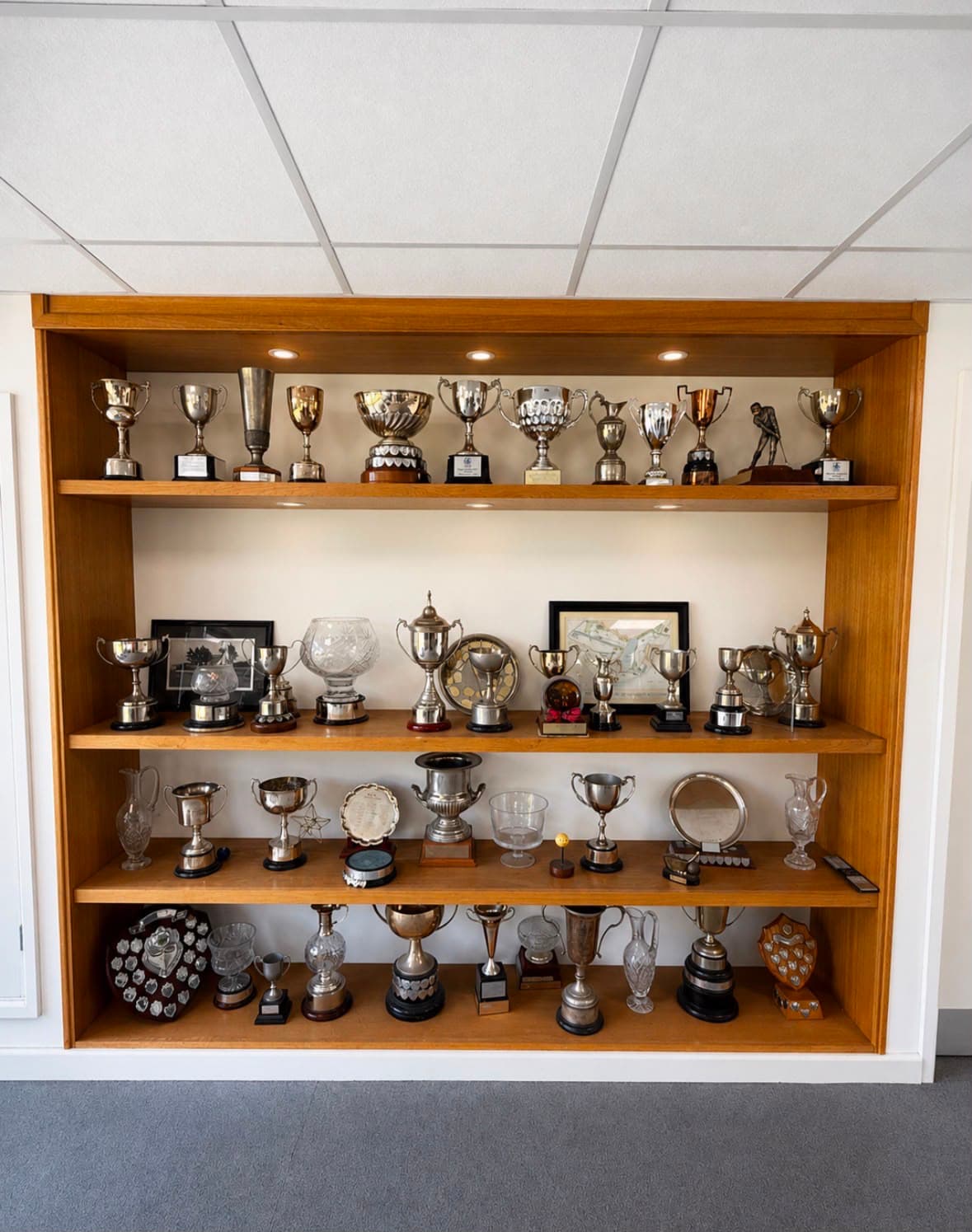
The club's trophy cabinet — silverware dating back through the club's history
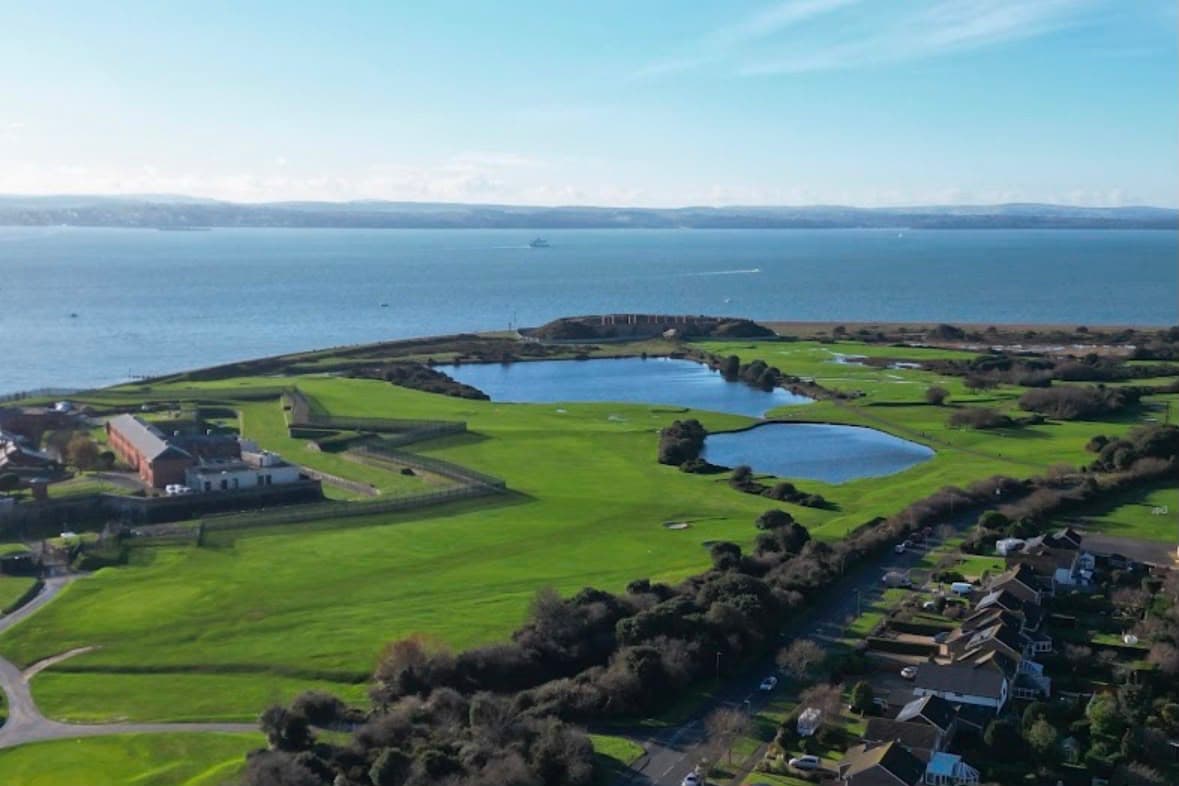
Aerial view of the links at Stokes Bay: Fort Gilkicker and the old moat ponds in the foreground, the fences bounding Fort Monckton to the left, and the Solent shipping channel and the Isle of Wight beyond